

NASA Will Begin a Simulated Mars Mission on May 10th.
NASA has selected 4 volunteers for a simulated Mars mission to be conducted in Earth’s environment. The simulated mission to the Red Planet will take place in a habitat created at NASA’s Johnson Space Center in Houston. It will simulate what it would be like for astronauts to live and work on Mars for 45 days. The team consists of Jason Lee, Stephanie Navarro, Shareef Al Romaithi, and Piyumi Wijesekara. The team will stay at NASA’s Human Exploration Research Analog (HERA) facility from May 10th to June 24th. This mission is part of NASA’s Human Research Program (HRP), which aims to find the best ways to keep people safe during space travel.  The journey the team will undertake will allow scientists to better understand the effects of isolation and remote conditions on the human body before future deep space missions. Throughout their one and a half month experience, the crew will not only conduct scientific research and perform operational tasks but also experience what it would be like to walk on the surface of Mars and communicate with mission control using virtual reality. By planning these simulations in advance, researchers will gain a better understanding of how to overcome the challenges that humans may face while exploring deep space.
  Although the HERA mission will last for 45 days, NASA also has simulation missions like the Crew Health and Performance Exploration Analog (CHPEA) that investigate what it would be like to live on Mars for a year. We’ll delve into this mission in upcoming briefs.
Spider-Like Shapes on the Surface of Mars
The European Space Agency (ESA) announced that the Mars Express orbiter has detected strange formations resembling spiders on the surface of Mars. ESA explained that these spider-like shapes are actually formed when sunlight falls on the accumulated carbon dioxide on the planet’s surface during the winter months. To explain in more detail; Just like on Earth, Mars experiences four distinct seasons. However, each Martian season lasts roughly twice as long as its Earth counterpart. According to ESA, these spider-like formations appear in the Martian spring when sunlight hits the layers of carbon dioxide accumulated during Mars’ dark winter. The sunlight causes the carbon dioxide ice in the lower layers to turn into gas, which accumulates and eventually breaks through the layers of ice around Mars’ poles. Once released, the dark material is dragged towards the surface, breaking up ice layers up to a meter thick.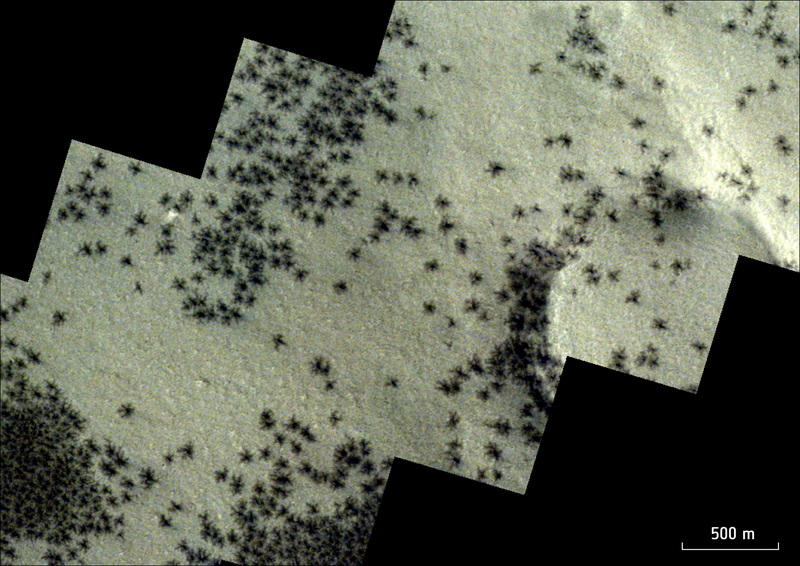 The resulting gas is filled with dark-colored dust and erupts upward from cracks in the ice, resembling a fountain. The gas then moves downward and settles on the surface. The settling gas creates dark spots. The same process also creates patterns resembling spiders etched beneath the ice.
The image was captured by the CaSSIS instrument on ESA’s ExoMars Trace Gas Orbiter (TGO) spacecraft. CaSSIS was built at the University of Bern in Germany. It generates high-resolution images designed to complete the data collected on Mars. It consists of a telescope and a focal plane system mounted on a rotating mechanism and has three electronic units that transmit the images back to ESA. 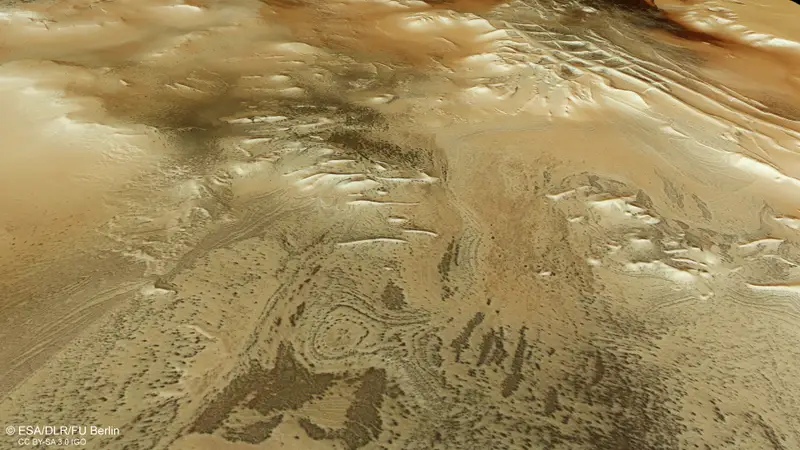
The Clearest Images Ever of the Horsehead Nebula Captured
The James Webb Space Telescope (JWST) has captured the clearest images to date of a zoomed-in portion of the Horsehead Nebula, one of the most prominent and iconic objects in the sky. The observations revealed the top part of this iconic nebula, resembling a horse’s mane, in infrared light with unprecedented resolution, showcasing the complexity of the region. The images focus on the western part of a dense region known as the Orion B molecular cloud, located in the Orion (the Hunter) constellation, where the Horsehead Nebula, also known as Barnard 33, shines with turbulent dust and gas waves, approximately 1,300 light-years away. While the Horsehead Nebula was originally a collapsing nebula, its brightness comes from a hot, young star located in the upper left corner. The surrounding gas clouds of the Horsehead have already dispersed, but the protruding pillar consists of dense material clumps, making it more resistant to erosion. In fact, this remaining part, which has resisted erosion, is what gives the nebula its characteristic shape and its name. Scientists estimate that this dense material pillar will also disappear within about 5 million years. 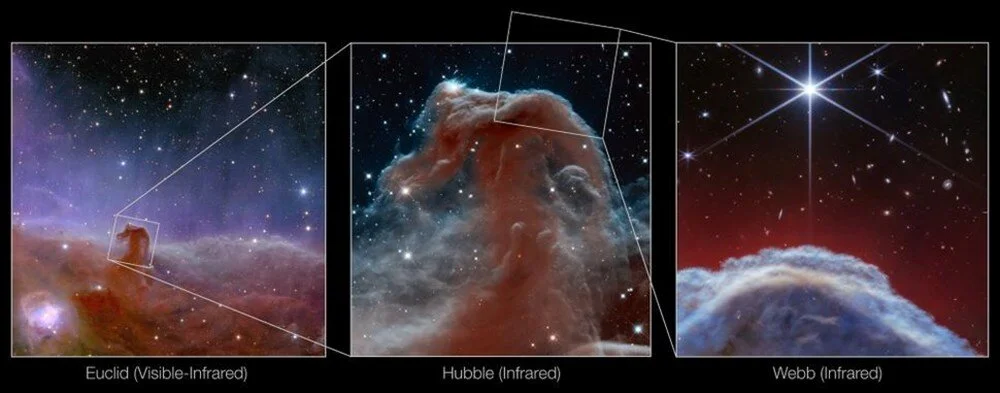 The Near-Infrared Camera (NIRCam) instrument of the James Webb Space Telescope managed to capture this small portion of the Horsehead Nebula in close-up and detail. Another primary camera of the telescope, the Mid-Infrared Instrument (MIRI), also succeeded in capturing an impressive image of the Horsehead Nebula.
While the Horsehead Nebula is a photon-dominated region (PDR), known as a region where young massive stars heat up the gas and dust between the stars, it also consists of cold clouds found between warmer ionized gas closer to newborn stars. Studying the light coming from PDRs allows scientists to understand how interstellar matter forms and the chemical processes that determine this evolution. The relative proximity of the Horsehead Nebula makes it an ideal object for such studies. 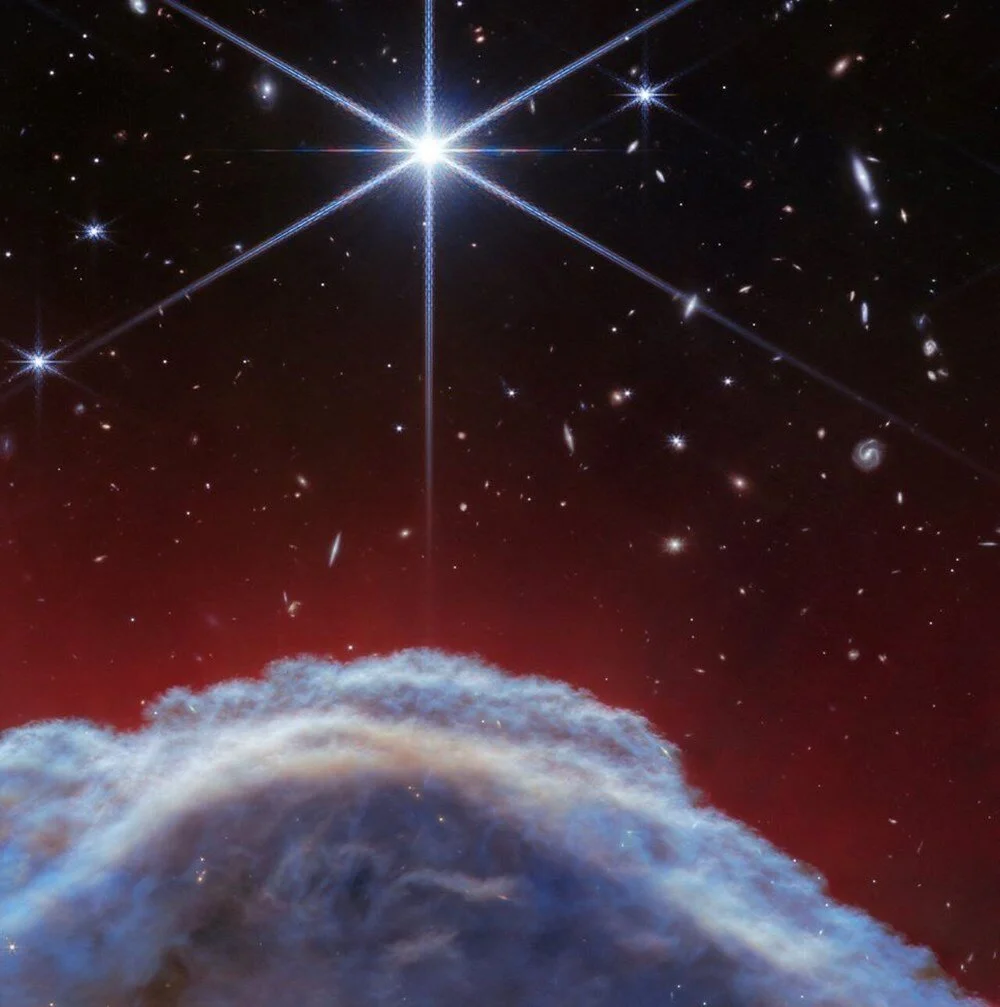
This Week In Our Art Corner
A Brief History of Time
A Brief History of Time is a popular science book by Professor Stephen Hawking, first published in 1988. Hawking tries to explain space science concepts such as the big bang, black holes, light cones, and superstring theory to readers who have no background in the subject. However, from time to time it goes into mathematical explanations that are more complex than one would expect from a popular science book. Upon the recommendation of an editor, no formulas other than E=mc² were included in the book. Hawking tried to simplify the subjects by enriching the texts with visuals such as pictures and graphics so that the concepts can be understood more easily. It is written in a language that everyone can understand. 