

The Earliest Summer Solstice Since 1796
The solstice occurs twice a year and marks the days when the Sun reaches its highest or lowest points relative to the equator, resulting in the longest and shortest days of the year. Depending on the hemisphere, these dates signify the start of the shortening or lengthening of days and nights. This year, the summer solstice will occur earlier than in recent years. In this article, we will discuss solstices and why this year’s summer solstice is happening earlier. 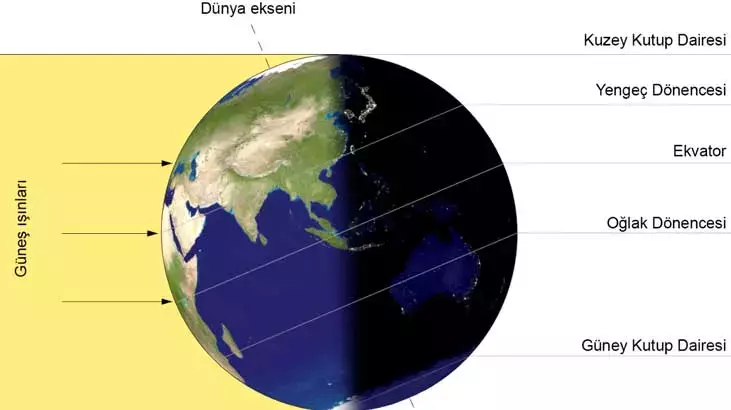 Today, June 21st, the publication date of our new newsletter, is normally considered the start of summer in the Northern Hemisphere and the start of winter in the Southern Hemisphere. On this date, the Sun’s rays hit the Tropic of Cancer at a 90-degree angle. The Northern Hemisphere experiences its longest day, while the Southern Hemisphere experiences its longest night and shortest day. Additionally, the circle of illumination just grazes the Antarctic Circle, and the sun’s rays hit at their shallowest angle of the year. After this date, the longest shadows are cast south of the Tropic of Capricorn, and shadow lengths begin to shorten. In Turkey, the longest day is experienced in Sinop on June 21st, while the longest night is in Hatay on December 21st.
During the winter solstice (December 21st), the Sun’s rays hit the Tropic of Capricorn at a right angle. In the Northern Hemisphere, the days begin to lengthen, while in the Southern Hemisphere, they start to shorten. This date marks the beginning of winter in the Northern Hemisphere and summer in the Southern Hemisphere. The Southern Hemisphere experiences its longest day, while the Northern Hemisphere has its longest night. It is also the day when shadows are longest in the Northern Hemisphere.
 Why Is the Solstice Early This Year? A Earth year is approximately 365 days, 5 hours, and 49 minutes, but we use a 365-day calendar. The Gregorian calendar, adopted in the late 16th century, accounts for this extra quarter day by adding an extra day (February 29th) every four years. In leap years like 2024, solstices and equinoxes occur about 18 hours earlier than in the previous year. In the years following a leap year, the seasons start about 5 hours and 49 minutes later than the previous year. Over time, this results in solstices and equinoxes shifting approximately 45 minutes earlier every four years, or about three-quarters of a day earlier each century. By the year 2096, the solstice will occur at its earliest point of this century.
Traveling to Mars Could Lead to Permanent Kidney Damage
Since the 1970s, space flights have been known to cause health issues in astronauts such as loss of bone mass, heart and vision problems, and the formation of kidney stones. These health issues are believed to be caused by exposure to space radiation, such as solar winds from the Sun and Galactic Cosmic Radiation (GCR) from deep space. The Earth’s magnetic field provides partial protection for manned space flights conducted in low Earth orbit. However, a manned mission to Mars would require astronauts to stay in space for at least several months. Research conducted at University College London suggests that a possible manned journey to Mars could leave astronauts with permanent damage. The study found that the structure and function of the kidneys change during space flight and that radiation causes permanent damage. Over 40 institutions from five continents participated in the UCL-led research. Experiments, including biomolecular, physiological, and anatomical assessments, were conducted to identify problems that might be encountered during long space journeys. These experiments included 11 space simulations involving mice and rats over 1.5 and 2.5 years. In these experiments, both human and animal kidneys were remodeled. It was discovered that kidney tubules tend to contract in space.  Researchers are exploring potential solutions to these problems. Dr. Keith Siew stated, “If we do not develop new ways to protect our kidneys, I would say that although an astronaut might be able to go to Mars, they might need dialysis upon their return.” Professor Stephen Walsh from the UCL Department of Renal Medicine mentioned that protection might not be effective, but as more is learned about the kidneys, it may be possible to develop technological or pharmaceutical measures to facilitate long-duration space travel.
The Return of Boeing Starliner Postponed
The first manned launch of the Boeing Starliner took place on June 5th, and the Starliner docked with the ISS the following day. According to a statement by NASA, Boeing’s Starliner capsule will remain at the International Space Station (ISS) for twice as long as initially planned. The mission, which was initially supposed to last nine days, is now expected to continue until at least June 22nd. As a result, the two NASA astronauts on the capsule will have to wait a bit longer in orbit. According to the statement, the capsule will depart from the ISS on June 21st and will land approximately six and a half hours later. This means that the Starliner crewed flight test will last about twice as long as originally planned. During this extended period, more detailed tests will be conducted on the vehicle, including the operation of the capsule’s hatch, the firing of thrusters, and the testing of the cabin’s interior temperature. Additionally, safety drills will be conducted to prepare the crew to ready the capsule in case of an emergency. The mission’s goal was to test the spacecraft in orbit and was initially planned to last about a week. 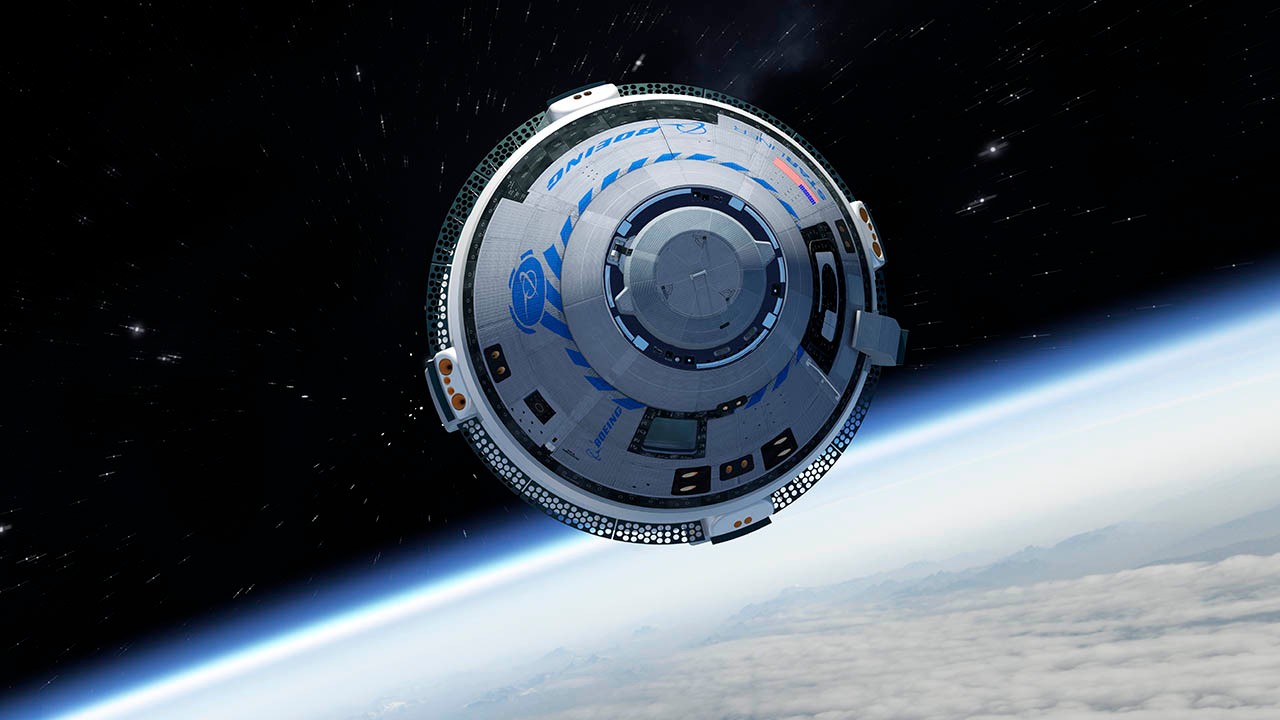 Steve Stich, NASA’s Commercial Crew Program Manager, said in a blog post: “We continue to understand the capabilities of Starliner to prepare for its long-term goal of performing a six-month docked mission at the space station.” Mark Nappi, Vice President and Program Manager of Boeing’s Commercial Crew Program, added: “We have an incredible opportunity to spend more time at the station and conduct more tests that provide invaluable data specific to our position.”
This Week In Our Art Corner
Black Hole Simulation
This new, immersive visualization produced on a NASA supercomputer represents a scenario where a camera — a stand-in for a daring astronaut — enters the event horizon, sealing its fate. This version is a 360-degree video that lets viewers look all around during the one-way trip.
Goddard scientists created the visualizations on the Discover supercomputer at the NASA Center for Climate Simulation.
The destination is a supermassive black hole with 4.3 million times the mass of our Sun, equivalent to the monster located at the center of our Milky Way galaxy. To simplify the complex calculations, the black hole is not rotating.
A flat, swirling cloud of hot, glowing gas called an accretion disk surrounds the black hole and serves as a visual reference during the fall. So do glowing structures called photon rings, which form closer to the black hole from light that has orbited it one or more times. A backdrop of the starry sky as seen from Earth completes the scene.
The project generated about 10 terabytes of data — equivalent to roughly half of the estimated text content in the Library of Congress — and took about 5 days running on just 0.3% of Discover’s 129,000 processors. The same feat would take more than a decade on a typical laptop.